DCI 1001: Intro to Digital Culture & Information
Winter 2027 — Tuesday/Thursday 3:00 - 4:30 PM — Building Room
The course website is a living document. It will change regularly to reflect the needs of the course.
What's Due?
- ReadTuesday reading: Syllabus (this site)
- ReadThursday reading: Reading 1
- HomeworkHomework 1
- ReadTuesday reading: Reading 2
- ReadThursday reading: Reading 3
- HomeworkHomework 2
- ReadTuesday reading: Reading 4
- ReadThursday reading: Reading 5
- HomeworkHomework 3
- ReadTuesday reading: Reading 6
- ReadThursday reading: Reading 7
- HomeworkHomework 4
- ReadTuesday reading: Reading 8
- ReadThursday reading: Reading 9
- HomeworkHomework 5
- ReadTuesday reading: Reading 10
- ReadThursday reading: Reading 11
- HomeworkHomework 6
- ReadTuesday reading: Reading 12
- ReadThursday reading: Reading 13
- HomeworkHomework 7
- ReadTuesday reading: Reading 14
- ReadThursday reading: Reading 15
- HomeworkHomework 8
- ReadTuesday reading: Reading 16
- ReadThursday reading: Reading 17
- HomeworkHomework 9
- ReadTuesday reading: Reading 18
- ReadThursday reading: Reading 19
- HomeworkHomework 10
- ReadTuesday reading: Reading 20
- ReadThursday reading: Reading 21
- HomeworkHomework 11
- ProjectTuesday: Final project presentations
- OtherThursday: Course reflection
Nothing due in the next 7 days. 🎉
Contact
Section titled “Contact”Prof. Dorian McIntush (he/they) — dmcintush [at] wlu.edu
Office hours: My on-campus hours are generally 10-5pm M-F. You are welcome to email me to set up a time to talk or schedule an appointment directly. Also happy to chat before or after class!
Course description
Section titled “Course description”What does it mean to be a citizen of a digital world? How do you think critically about the ways that technology shapes our society? How do you learn new digital skills when platforms are constantly changing? How do you find and use information effectively without being overwhelmed or mislead?
Through hands-on activities and project-based learning, this course serves as an introduction to the study of digital culture and information. Students will develop the critical capacity and technological fluency necessary to understand, analyze, critique, and create in a world dominated by digital media, software algorithms, and information overload.
Course objectives
Section titled “Course objectives”Students will:
- Develop awareness of themselves as citizens of a digital world with accompanying rights and responsibilities.
- Build the technical skills necessary for academic, professional, and personal success.
- Communicate effectively and ethically with digital media to academic and general audiences.
- Create a digital project in a multi-disciplinary, collaborative environment.
DCI Learning Outcomes
Section titled “DCI Learning Outcomes”- Analyze the role of technology and digital media in contemporary culture.
- Develop the technical skills necessary for academic and professional success.
- Communicate with digital media to both academic and general audiences.
DCI Learning Goals
Section titled “DCI Learning Goals”- Engage in collaborative, interdisciplinary, project-based learning.
- Develop digital projects that contribute to the scholarly conversation in the student’s field of study and demonstrate an awareness of the technological and critical needs of the discipline.
- Develop an online professional identity and a portfolio of work in the minor.
Learn more about the DCI minor on our website.
Required texts
Section titled “Required texts”All readings are available freely online or through Leyburn Library’s subscriptions.
AI policy
Section titled “AI policy”Generative AI tools (software that creates new text, images, computer code, audio, video, and other content) are widely available. Well-known examples include ChatGPT, Claude, and Gemini for text and DALL•E and Midjourney for images, as well as AI features in services like Grammarly. This policy governs all such tools, including those released during our term together.
You may use generative AI tools on assignments in this course, within the following limitations: If you do use generative AI tools on assignments in this class, you must properly document and credit the tools themselves. You must also include a short reflection about your AI use: why you used it, what you used it for, how you checked any information given to you for accuracy. If you do not use generative AI, you do not need to complete this step.
If you choose to use generative AI tools, please remember that they are typically trained on limited datasets that may be out-of-date. Additionally, generative AI datasets are trained on pre-existing material, including copyrighted material; therefore, relying on a generative AI tool may result in plagiarism or copyright violations.
Finally, keep in mind that the goal of generative AI tools is to produce content that seems to have been produced by a human, not to produce accurate or reliable content; therefore, relying on a generative AI tool may result in your submission of inaccurate content.
It is your responsibility, not the tool’s, to assure the quality, integrity, and accuracy of work you submit in any college course.
Misuse or unauthorized usage of generative AI tools may constitute an Honor Violation, which can be further expounded in the White Book. Please communicate with me if there is any confusion regarding its usage for assignments, assessments, or any other coursework.
Please maintain integrity, for your learning, your personal character, and academic record. You should also know that I will not be using AI to grade your work, nor have I used it in preparation of course materials.
Accommodations
Section titled “Accommodations”I am committed to ensuring access to course content for all students. Reasonable accommodations are available for students with disabilities. Contact Lauren Kozak, Title IX Coordinator and Director of Disability Resources, to confidentially discuss your needs and the accommodation process. More information can be found at: https://www.wlu.edu/disability-accommodations/undergraduate-disability-resources
If you have already been approved for accommodations, please meet with me within the first two weeks of the term so I can develop an implementation plan together. It is important to meet as early in the term as possible; this will ensure that your accommodations are implemented early on. If you have accommodations for test-taking, please remember that arrangements must be made at least a week before the date of the test or exam.
Protocols
Section titled “Protocols”- If you have ever labeled yourself as “bad at technology,” you are welcome in this course. There is no assumed technical skill.
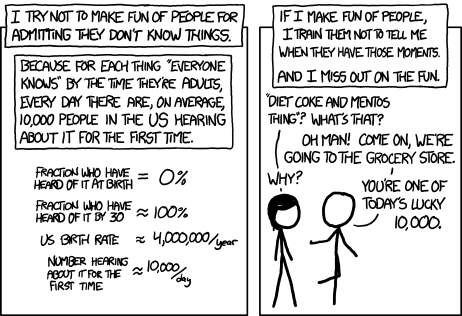
- “Technology” is a lot of things. Chances are you will know something about it that your classmates do not. Be generous about teaching and learning from each other. See also: xkcd 1053: Ten Thousand by Randall Munroe.
- Your laptop will be a major player in this course, even more than usual. Please make sure it is good working order by updating software (operating system, browers, etc) and visiting the IT help desk as necessary.
- That being said, using your laptop in class is not an invitation to distraction. Look up how to disable notifications since you will have to share your screen in class.
- This course will mix theory and hands-on work. Be prepared to think critically about technology AND to get your hands dirty in a little bit of code. The DCI community experimentation and productive failure, often in public. We will learn from how and why things don’t work. We are not just going to talk about what we’re learning but how we’re learning it. Give yourself a break from perfectionism!
License
Section titled “License”
This work is licensed under a Creative Commons Attribution-NonCommercial-ShareAlike 4.0 International License.